Coaching ambition
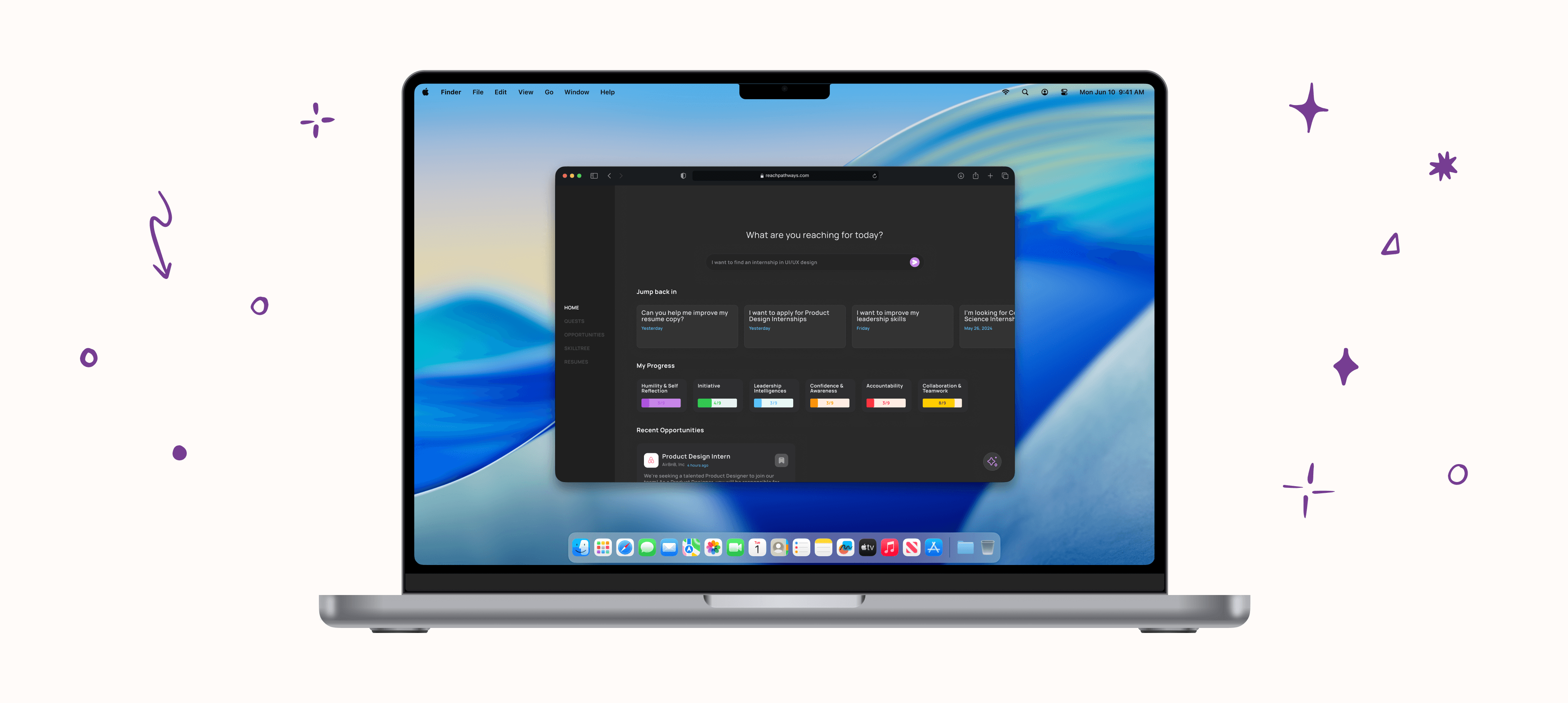
REACH Pathways is an AI-native, gamified career platform helping high-achieving under-resourced students build resumes, gain leadership skills, and access college and career opportunities.
Outcome
I led design and frontend on REACH’s MVP, launched at roughly 12,000 students. The platform anchored a $1.99M raise that closed weeks after our engagement ended and now serves over 40,000 users. The AI-powered resume builder, in particular, has become the feature students name first when they describe what REACH does for them.
Problem
High-achieving students from under-resourced backgrounds were getting into college and into competitive programs, but stalling at the next step. Building a resume. Naming their skills. Knowing which scholarship or internship was even worth applying to. Chicago Scholars had the curriculum, the mentors, and the network to fix this. What they didn’t have was a product. They came to MJV to build the MVP that would eventually spin out as REACH Pathways and license to other organizations.
The brief had two non-negotiables. The platform had to feel fun, drawing from video game culture rather than from typical edtech. And it had to take its students seriously, since the audience was high-achieving, not remedial.
What I Owned
I led product design and frontend development on the MVP. I designed the home layout, navigation, resume builder, mobile views, and the visual system for the skill tree, working with a junior designer on the latter. As lead frontend developer, I built the web app in Next.js and TypeScript with Eric Smith, then connected it to the APIs and LLM endpoints the rest of the MJV team built. Kenneth Woodard, REACH’s head of product, was my main feedback partner and brought the strongest product instincts on the client side.
Approach
I started with Discord and Steam as primary references rather than edtech. Discord for the social, dark, ambient feel. Steam for how it treats progression as something visual and earned. Most career-readiness platforms look like a Google Form. We wanted REACH to look like somewhere a student would open on a Sunday afternoon by choice. The existing brand (purple, dot patterns) gave me a starting palette to push into a more game-native direction.
The Skill Tree
Kenneth came in with the seed of the idea, that a student’s progress should look like a tree or web rather than a checklist. I designed the system underneath it. Each node became a quest with its own icon and state (locked, available, in progress, complete). Clicking a node opened the quest detail, which broke down into sub-tasks the student worked through. The terminology took a few rounds to settle. Quests, tasks, modules, sub-tasks were all in play before we landed on a hierarchy that students and the curriculum team could both reason about.
The skill tree became the navigational and emotional center of the product. It’s the screen a student sees first, and it’s the screen that turns abstract growth into something visible.
The AI Resume Builder
This was my first time designing an AI interface, and in early 2024 there wasn’t much prior art for what a conversational agent inside a form should feel like. The MJV team built the conversation API. I designed the interaction model.
I made the AI assistant feel omniscient about the form. As the student moved between sections, the assistant tracked which step they were on. After a short pause it would proactively send a tip relevant to that section. The student could also ask it anything at any time. The technical work on my side was tracking the current form step and current context and passing that into the conversation, so the agent always knew where the student was without the student having to explain.
It’s the feature students name first when they describe REACH. In hindsight I would have pushed the conversational layer further and let it carry more of the form itself, but the simple form plus hovering agent pattern was novel for the moment and held up well.
What Was Hard
The curriculum was being designed in parallel with the product. Skills, quests, and learning objectives shifted as the Chicago Scholars team refined what they wanted students to actually walk away with. The design had to keep up. I learned to build flexible enough patterns that a curriculum change didn’t mean a redesign, just a content swap.
The other challenge was design by committee. With a CEO, a head of product, a head of technology, and the curriculum team all weighing in, feedback often pulled in three directions at once. The work moved faster on the weeks I could route a clear question to a single decision-maker, usually Kenneth, and slower on the weeks decisions had to round-robin through everyone.
Outcome
The MVP shipped to roughly 12,000 students at launch. The platform anchored REACH’s $1.99M raise weeks after our engagement ended, and the team has since scaled it to over 40,000 users. The resume builder remains the feature students cite most often. The skill tree became the core navigational metaphor that the platform has continued to build around.
What I take from this project is the AI interaction work. Designing a conversational agent that feels aware of where the user is, without being intrusive, was the hardest design problem and the most useful one to have solved early. It’s shaped how I approach AI-native product design on every project since.
Before
After